So at the moment, both major political parties are dealing with their own sexual misconduct scandals. The GOP's is Alabama Senator Roy Moore, who just over two weeks away from a special election in his home state, the winner of which fills a vacant United States Senate seat. Meanwhile, the Democrats are dealing with a growing number of allegations against Minnesota's comedian-turned-Senator Al Franken, as well as Michigan Representative John Conyers, who also happens to sit on the fairly important House Judiciary Committee. Or, he used to, anyway; on November 26th, Conyers stepped down from that committee as part of the investigation into the allegations against him.
Amazingly (to me, anyway; Congress' complete lack of morality still shocks me, despite everything I've seen), key leaders from both parties found ways to excuse their colleagues' misdeeds - probably while contemplating the overall agenda. On one side of the aisle, Senate Majority Leader Mitch McConnell contemplated the idea of urging Luther Strange (Alabama's temporarily appointed Senator) to resign, as a way of avoiding the state's upcoming special election. On the other side, Nancy Pelosi waffled and refused to mete out a harsher punishment than some stern language toward Conyers.
That's sad and disgraceful, especially by the Democrats. Franken and Conyers's disgusting actions are nowhere near as bad as Moore's vile pedophilia, but neither of the two Democrats appear to be squeaky clean either. Their punishments should be more severe, given the apparent patterns of misbehavior on both their parts. I've long since given up expecting even the slightest shred of decency from the GOP - why would I think a party that condones Trump's behavior, associates with Nazi sympathizers like Steve Bannon and Seb Gorka, and panders to the worst parts of society, like racists and science deniers? The GOP is a lost cause.
But the Democrats want to take back Congress next year, and the Presidency in 2020. A lot of Americans want them to, also. But why should the country vote them back in, if this is the standard for acceptable conduct they're setting? Now, some of the rank-and-file Congressmen have known Franken and Conyers for years. They've probably played together for Congressional softball games, or gone on "fact-finding" junkets together, or shot the breeze at weekend BBQs or after-work dinners at DC's finest restaurants. Pelosi is not a rank-and-file Democrat, though. She's in a leadership position, which means two things. First, she's not there to be anybody's friend; her job is to take responsibility for problems and fix them. Second, her colleagues and constituents look to her to set the standard for acceptable conduct, and she just told them all that bad behavior will still be acceptable, unless you really get out of control.
Unlike Kay Ivey, Pelosi is smart enough to not publicly state her reasons, but she's letting Conyers off with a light punishment for the same reason that the GOP won't abandon Moore: both parties consider keeping Congress full of their members crucially important. And yes, it is important. Trump and the GOP are pushing a lot of destructive policies: the tax plan, the ACA mandate repeal, judicial nominees. Given those things, isn't keeping Franken and Conyers in play a necessary evil?
No. NO. This is bigger than the GOP's horrible governance. Americans need elected officials to stop the GOP cold, but they (we) also need those same officials to start regaining our trust. Part of what made the 2016 election stand out was that a large portion of the electorate rejected the status quo. Voters sent a loud, powerful signal to Washington, and just over a year later, it doesn't seem like Washington got that message. If the Democrats would clean out their own house, it would be a sign that they're hearing us. The GOP legislation will hurt, but abandoning all sense of ethics to score a legislative win will hurt more in the long run, by further eroding Americans' trust in governmental institutions. This isn't war, and the stakes aren't so high that you need to collaborate with the devil like FDR did, in order to win.
The Democrats have a choice. They can cross any lines, abandon any morals, do whatever it takes to push back against the GOP, and probably gain some short-term victories. Or they can act with honor, integrity, and decency, and show the American public they are fit to govern. They can put the country ahead of a legislative "win" for their party. They can help make Americans proud of their elected officials again, instead of being embarrassed of the current pack of miscreants and dirtbags. That's worth more than a few legislative victories.
Monday, November 27, 2017

Hard Times and Heroes
"It's only in the face of horror that you truly find your nobler selves. And you can be so noble. So, I'll bring you pain, I'll bring you horror, so that you may rise above it." - Tilda Swinton as Gabriel, Constantine (2005)
Hollywood uses an occasional plot device to make the heroes become heroes: someone will inflict a tragedy upon them so that they rise to the occasion and reach their greatest potential. Nick Fury kind of did it in The Avengers. Gabriel wants to do it for all of humanity in Constantine. And maybe in Donald Trump's and the GOP's twisted brains, that's what they think they are doing. Rolling back so many of our current safety/civil rights/environmental/workers' rights protections, that we, as Americans, get off of our lazy, selfish, entitled asses and fight like hell to get them back. Thus Making America Great Again in the process.

Hollywood uses an occasional plot device to make the heroes become heroes: someone will inflict a tragedy upon them so that they rise to the occasion and reach their greatest potential. Nick Fury kind of did it in The Avengers. Gabriel wants to do it for all of humanity in Constantine. And maybe in Donald Trump's and the GOP's twisted brains, that's what they think they are doing. Rolling back so many of our current safety/civil rights/environmental/workers' rights protections, that we, as Americans, get off of our lazy, selfish, entitled asses and fight like hell to get them back. Thus Making America Great Again in the process.

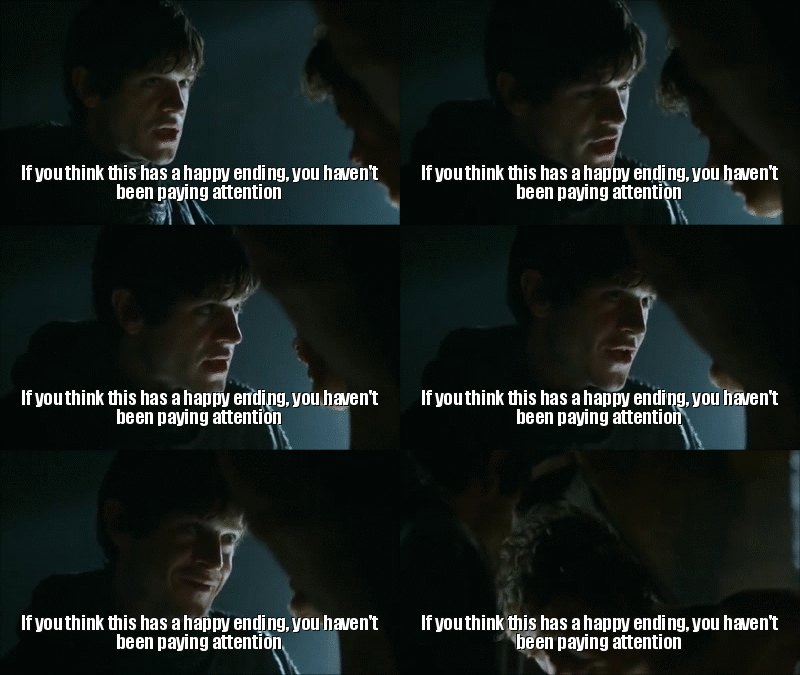
That paragraph above is sarcasm, by the way. It's more likely that Trump & the GOP, along with their corporate paymasters, don't give a shit about anyone but themselves. They've never cared if America becomes a giant shit heap as long as they're at the top of the heap; and now they're working feverishly to accelerate the defecation process. So what happens if we let this continue unimpeded? I'll let Ramsay Bolton answer that:
Tuesday, November 21, 2017
Rollerblading, Demagogues, and Economic Downturns
A post-apocalyptic dystopia is a quick, easy setting for any story: just drop the protagonist(s) in the middle of a really messed-up situation, and have them fight like hell just to survive. A lot of well-known works began in the aftermath of some catastrophic event: The Hunger Games, Mad Max, Logan's Run, 1984, and Brave New World, to name a handful of popular ones. Naturally, there are a lot of lesser-known ones, such as the one that's the subject of this post.
Back in 1990, a B-movie called Prayer of the Rollerboys came out. Since its major selling points were Corey Haim and rollerblading, when rollerblading came close to being cool (Was rollerblading ever cool? I thought it was, but I was probably in the minority), I'm guessing that you haven't seen it. It was mostly forgettable, but it had a unique angle on the dystopian society setting. The story begins several years after the United States has suffered a massive economic crash, and the Rollerboys are a powerful crime organization that rose to prominence in its wake. The group pulls in money by dealing a fictional drug called "mist", and promotes a lot of overtly racist ideology. I won't recap any more of the plot, because it's really not important; but the backstory and setting seemed interesting, which is why this movie gets a blog post about it. The movie's first few minutes contains a monologue by the Rollerboys' leader, which provides important context to the movie. It's also important to this post, so I'm going to quote it here:

History is like a never-ending game of Russian Roulette, and nobody can predict when the gun will go "bang" when someone pulls the trigger. I'd tell people to not read too much into this movie, and just see it as historical allegory.
Back in 1990, a B-movie called Prayer of the Rollerboys came out. Since its major selling points were Corey Haim and rollerblading, when rollerblading came close to being cool (Was rollerblading ever cool? I thought it was, but I was probably in the minority), I'm guessing that you haven't seen it. It was mostly forgettable, but it had a unique angle on the dystopian society setting. The story begins several years after the United States has suffered a massive economic crash, and the Rollerboys are a powerful crime organization that rose to prominence in its wake. The group pulls in money by dealing a fictional drug called "mist", and promotes a lot of overtly racist ideology. I won't recap any more of the plot, because it's really not important; but the backstory and setting seemed interesting, which is why this movie gets a blog post about it. The movie's first few minutes contains a monologue by the Rollerboys' leader, which provides important context to the movie. It's also important to this post, so I'm going to quote it here:
"Before many of you were born, our parents caused the great crash. They were consumed with greed. They ignored repeated warnings, and borrowed more money than they could ever repay. They lost our farms, lost our factories, lost our homes. Alien races foreclosed on our nation while we--we were locked in homeless camps. Now America belongs to the enemy. Forget your parents. They didn't care about us. We are the new generation, and we are the remedy. You need a new family--a family that cares. The Rollerboys care. Join with us. Let us be your strength. Let us be your warriors. Help the white army win back our homeland. The Day of the Rope is coming."That little speech pretty much gives away the fact that the movie is an analogy for Nazi Germany, and several other parts of the movie reinforce this connection. It also relies on the traditional wisdom about economic hardship creating an opportunity for demagogues and wanna-be despots to gain power, which has happened countless times throughout recorded history. Some people might also see it as a cautionary tale for America, because the government's trend of racking up massive deficits has raised alarms from some economists. One could draw further parallels to this movie by referencing any number of news headlines, because there is never a shortage of things to prompt severe panic. Maybe America is on the verge of crashing into total disaster, who knows? I could point to events during each of the past five or six decades where a lot of people thought the country was verging on ruin too. (I might do a blog post about that in the future.)

History is like a never-ending game of Russian Roulette, and nobody can predict when the gun will go "bang" when someone pulls the trigger. I'd tell people to not read too much into this movie, and just see it as historical allegory.
Saturday, November 11, 2017
Remembrance Day 2017
"In combat, there are no winners. The victors just happen to lose less than the vanquished. One side may impose its will on the other, but there is nothing noble or virtuous about the process. People are killed and maimed, homes and communities are destroyed, lives are shattered, families are broken apart and scattered to the wind--and just a few years later, we can barely remember why." - Eric L. Haney, Inside Delta Force
November 11th is recognized in a slightly different way in many other countries. Here in the United States, we observe Veterans Day, while Great Britain and several of its former territories call it Remembrance Day, and other nations observe Armistice Day. These holidays both trace their origins back to the end of World War I, specifically the signing of the armistice that officially brought the war to a close. It seemed like a symbolically fitting way to commemorate the event. World War I devastated most of Europe in an unspeakably horrific conflict that nobody wanted to repeat. That's why a lot of people associate it with the phrase "the war to end all wars," because its sheer destructiveness was enough to inspire mankind to end war forever.
But that is a wildly naive and idealistic goal, and people knew it even immediately after the Great War. War has been around since the first prehistoric clans of people bumped into each other, and it's still with us a couple of billion people later. We can design weapons with unprecedented destructive capability, believing that if the stakes get high enough nobody will want to fight - and yet, nations still find ways to fight. We can proliferate technology that helps make us more interconnected - and people still find reasons to fight. War has always, and will always, be with us.
And maybe that's not necessarily a bad thing. Occasionally (very rarely, in my opinion) there's a valid reason for the organized brutality of war. Maybe it's a severe injustice that can't be remedied any other way, or a tyrant whose aggression needs to be checked. But no matter what reasons are behind it, war is always horrific, whether it's a single bomb that obliterates an entire city, an emplaced machine gun that mows down charging troops by the dozen, or a roadside bomb that rips an armored Humvee apart like an aluminum soda can.
Perhaps that's why Remembrance Day or Armistice Day seem more appropriate to me. They are more of an acknowledgement that while we can't eliminate war, we should always remember its destructive cost, so that we work as hard as we can to avoid it as much as possible.
Saturday, October 28, 2017
Anthropomorphic Stuffed Tigers, Bratty Kids and Western Philosophers
This is such an obvious topic, I'm surprised I didn't think to write about it sooner. I'm talking about one of the best comic strips of all time, and its subtle symbolic representation of two prominent Western philosophers.

This is going to be a short entry, because there isn't a lot to say, honestly. The gist is that Bill Watterson, Calvin & Hobbes' creator, partially based both of them on the philosophers John Calvin and Thomas Hobbes. He used the philosophers as a basis for the characters' names, and incorporated bits & pieces of the philosophers' teachings into the characters' personalities and beliefs. Here's one example:

It's a brilliant allegory that I went years without noticing. Calvin (the theologian) believed in predestination, while Hobbes (the theorist) did not - although Hobbes (if I'm reading this right) also rejected the concept of free will.
There are many other examples of the philosophers' teaching popping up throughout the comics. I may have to revisit my Calvin & Hobbes collection soon, to see how many I can spot.
Thursday, October 26, 2017
Hacking Pandora's Server
This is going to be a hot take (I think that's the term kids are using these days - okay, I'll stop trying to be cool now) about a news story I saw earlier. BoingBoing reports that computer techie types meshed an NSA cyberweapon with an old ransomware strain, and used amalgamation in the Wannacry ransomware attack from May of this year.
Here's what I think is the most important part of the story: the US develops this revolutionary super-weapon, and some unscrupulous party gets their hands on it, leading to dire consequences. This isn't the first time something like this has happened, by the way. I'm beating the drum about nuclear weapons because they provide many examples of dire consequences, but there are other weapons and technologies we probably don't want falling into the wrong hands. For example, UAVs (drones). Right now, the United States has a substantial lead in drone technology over other countries, but it's naive to think that could never change. Despite the justifiable criticisms of how America employs drones, it has shown some level of restraint (such as mostly refraining from conducting strikes over major urban areas - see the two images below).


The MQ-9 Reaper can carry several different munitions, including an air-to-ground antitank missile. Imagine what one of those could do to a crowd of people in a major city. Do you think it's impossible that someone might give the order to do so eventually?
Here's what I'm getting at. The United States is pretty talented when it comes to creating new weapons, but it doesn't put a lot of thought into anything after that. This lack of planning eventually comes back to haunt us, because other countries or groups figure out how to copy our tech or make their own versions. It's arrogant to think that we're the only country smart enough to invent these things.
So what's the answer? Do we destroy these weapons once we realize the potential damage they could create, along with all the research behind them? That's a good thought. Imagine if the people spearheading the Manhattan Project demolished all the machinery and burned their notes right after the Trinity Test, or Fritz Haber destroyed his work in 1914. Wouldn't we all be better off? Not necessarily. Like I said earlier, it's arrogant to assume that nobody else can develop something. The US wasn't the only nation conducting atomic weapons research in the 1930s and 1940s; if it had unilaterally halted development on the A-bomb, what country would have been the first to develop one? Probably the Soviet Union. How different does the Cold War look if the USSR is the only country with this weapon of unprecedented destructive capability? Even the stolen NSA techno-weapon worked so well because the agency smugly assumed nobody else would discover the vulnerability in Microsoft's SMB protocol that it found. Oops.
The best solution I can come up with is to define what is or isn't permissible early on, when you're the only one in possession of this new weapon. The way you use the weapon creates a norm for the rest of the world on what's acceptable. At the same time, start crafting and implementing international laws and conventions to govern the use of this new weapon; so that there's a standard with a little more authority than an unofficial norm in place. None of these things are perfect, and nations (or people) can violate norms, laws, or conventions at will; but it's better than nothing. And getting ahead of the problem in this way is easier than rushing to play catch-up once the weapon is everywhere.
Finally, stop using the weapon the way a kid treats an expensive new toy on Christmas morning. Looking at you, United States.
Wednesday, October 25, 2017
The Question of Equality
There was this short story Kurt Vonnegut published in 1961 called Harrison Bergeron. I first read when I was a freshman at Gonzaga University, back in 1998, and it kind of stuck with me since then. It's short enough that you can read the whole thing in about five minutes (here's a link to the whole story), but a core element of the story is that it's set in a society where everybody has been made equal. Intelligent people wear earphones that broadcast distracting noises at regular intervals, attractive people wear ugly masks, strong people must constantly wear extra weights, and so on. The reason for this was to discourage competition and make sure nobody had an advantage over anybody else.
So why am I talking about some fifty-year-old Vonnegut novella that I read about a long time ago? Well, because it's core theme of universal equality ties in to a bunch of centuries-old writings by some very smart and observant people. First, there was this French citizen named Alexis De Tocqueville. Tocqueville spent some time in the United States a few decades after the Revolutionary War and the signing of the Constitution. At the time of his journey, democracy was something of a new concept in the Western world, and France was one country still figuring out what it meant. Tocqueville found many things to praise about American democracy, but he also found some potential flaws.
One such problem was what Tocqueville called the "equality of conditions", a phenomenon which he felt could eventually lead to a lack of freedom. His thinking was that the seeds of the problem were planted because democracies tend to grant significant authority to the citizens, giving them the impression that their opinions mattered just as much as anyone else's. Tocqueville believed this could lead to the tyranny of the majority pretty quickly, as well as setting the stage for further problems. First, he speculated that the fear of tyranny of the majority would cause some people to grow reluctant to voice their opinions, so they didn't land on the wrong side of the issue as the majority. If you don't think that could happen, go read up on the Asch Experiments.
Tocqueville also worried that the fear of majority rule could lead to a backlash, where citizens developed a skewed version of individualism, one marked by increased materialism. I don't fully understand Tocqueville's points here, but he seems to be saying that the materialism becomes a way for someone to reaffirm their individual significance: "Look at all the stuff I have! I matter!" This individualism would also lead to a breakdown in communal bonds (something Tocqueville considered important). As people became more isolated, they turned to the government to provide goods and services which their communities once did. Tocqueville called this condition of being overly reliant on the government "democratic despotism", which created a massive bureaucratic government that could easily enforce real despotism. The Founders were really worried about that, remember?
(By the way, it's probably not a coincidence that Tocqueville is a fan of conservatives and libertarians, because of his remarks about "democratic despotism"; one site I visited while researching this piece tried to connect social safety programs to Tocqueville's despotism and socialism/communism. Quite the slippery slope argument.)
Tocqueville understood that there was an inverse relationship between equality and liberty, and so did the Founders. This is pointed out in Federalist 10, one of the most well known Federalist writings, in a slightly roundabout way:

So am I against legislation like the Civil Rights Act, the ADA, the social safety net, a progressive income tax, and all the other programs that help make the playing field a little less uneven? Of course not. I'm just pointing out the potential dangers of taking it too far. There is also another type of equality I think is preferable: equality of opportunity. I didn't get a chance to really look into it in-depth, but an easy analogy is a running race, where everybody takes off from the same starting line. This picture sums up what I think is an optimal solution to work toward.

So, that is kind of a long one. I guess I was making up for taking such a long break. Anyway, enjoy.
So why am I talking about some fifty-year-old Vonnegut novella that I read about a long time ago? Well, because it's core theme of universal equality ties in to a bunch of centuries-old writings by some very smart and observant people. First, there was this French citizen named Alexis De Tocqueville. Tocqueville spent some time in the United States a few decades after the Revolutionary War and the signing of the Constitution. At the time of his journey, democracy was something of a new concept in the Western world, and France was one country still figuring out what it meant. Tocqueville found many things to praise about American democracy, but he also found some potential flaws.
One such problem was what Tocqueville called the "equality of conditions", a phenomenon which he felt could eventually lead to a lack of freedom. His thinking was that the seeds of the problem were planted because democracies tend to grant significant authority to the citizens, giving them the impression that their opinions mattered just as much as anyone else's. Tocqueville believed this could lead to the tyranny of the majority pretty quickly, as well as setting the stage for further problems. First, he speculated that the fear of tyranny of the majority would cause some people to grow reluctant to voice their opinions, so they didn't land on the wrong side of the issue as the majority. If you don't think that could happen, go read up on the Asch Experiments.
Tocqueville also worried that the fear of majority rule could lead to a backlash, where citizens developed a skewed version of individualism, one marked by increased materialism. I don't fully understand Tocqueville's points here, but he seems to be saying that the materialism becomes a way for someone to reaffirm their individual significance: "Look at all the stuff I have! I matter!" This individualism would also lead to a breakdown in communal bonds (something Tocqueville considered important). As people became more isolated, they turned to the government to provide goods and services which their communities once did. Tocqueville called this condition of being overly reliant on the government "democratic despotism", which created a massive bureaucratic government that could easily enforce real despotism. The Founders were really worried about that, remember?
(By the way, it's probably not a coincidence that Tocqueville is a fan of conservatives and libertarians, because of his remarks about "democratic despotism"; one site I visited while researching this piece tried to connect social safety programs to Tocqueville's despotism and socialism/communism. Quite the slippery slope argument.)
Tocqueville understood that there was an inverse relationship between equality and liberty, and so did the Founders. This is pointed out in Federalist 10, one of the most well known Federalist writings, in a slightly roundabout way:
I've been making a roundabout argument myself, but I'm referencing Vonnegut and Tocqueville to point out the parallels between Vonnegut's story and Tocqueville's observations. Vonnegut was being somewhat satirical by taking the concept of equality to an absurd conclusion, but the dangers Tocqueville foresaw are real. And to some degree, they have already happened: I think the 2016 election is a good example of what happens when a large number of people decide that their uninformed opinions are just as valid as the opinions of people who have done their research. Tocqueville understood what Socrates taught several hundred years ago, regarding the dangers of democracy; and I think he'd also agree wholeheartedly with this awesome quote.By a faction, I understand a number of citizens, whether amounting to a majority or a minority of the whole, who are united and actuated by some common impulse of passion, or of interest, adversed to the rights of other citizens, or to the permanent and aggregate interests of the community. There are two methods of curing the mischiefs of faction: the one, by removing its causes; the other, by controlling its effects. There are again two methods of removing the causes of faction: the one, by destroying the liberty which is essential to its existence; the other, by giving to every citizen the same opinions, the same passions, and the same interests.

So am I against legislation like the Civil Rights Act, the ADA, the social safety net, a progressive income tax, and all the other programs that help make the playing field a little less uneven? Of course not. I'm just pointing out the potential dangers of taking it too far. There is also another type of equality I think is preferable: equality of opportunity. I didn't get a chance to really look into it in-depth, but an easy analogy is a running race, where everybody takes off from the same starting line. This picture sums up what I think is an optimal solution to work toward.

So, that is kind of a long one. I guess I was making up for taking such a long break. Anyway, enjoy.
Subscribe to:
Posts (Atom)